
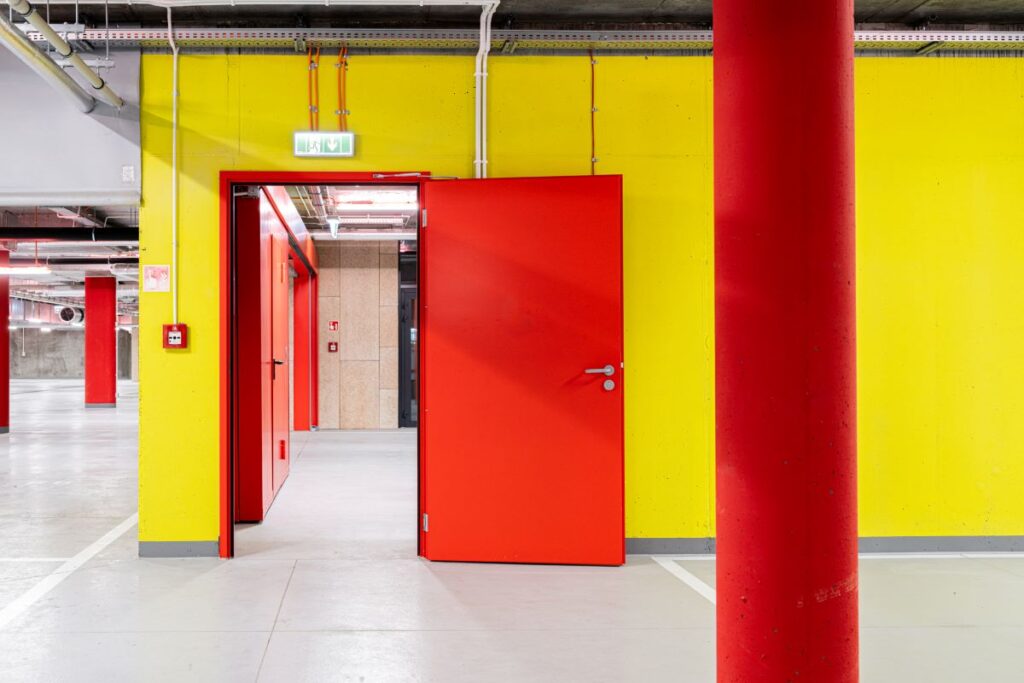
A fire door can carry several performance classifications at the same time, and often does. Each measures a different thing, verified by its own test. Reading them together — rather than reaching for a single FD number — is what separates a sound specification from a hopeful one.
Fire door performance is expressed through a set of independent classifications, each with its own test: fire resistance (E, EI to EN 13501-2), smoke control (Sa, S200), acoustic reduction (Rw in decibels), thermal transmittance (U-value) and, for some doorsets, security (RC classes to EN 1627). A doorset can hold several at once, and each must be specified and evidenced separately.
The habit of writing “FD60” into a schedule hides how much a fire door is actually asked to do. A modern steel doorset is a multi-performance component: it resists fire, it can control smoke, it can reduce sound, it can contribute to the thermal envelope, and in some configurations it resists forced entry. Each of these is a distinct classification with its own test regime. This guide takes them one at a time.
Fire resistance — E and EI
Fire resistance is classified under EN 13501-2 from EN 1634-1 test evidence. E verifies integrity — resistance to the passage of flame and hot gases. EI adds insulation — limiting temperature rise on the unexposed face. EI matters wherever the unexposed side of the door is accessible to occupants during a fire, such as a protected escape route, because a door that stays intact but radiates heat can still block escape.
All DFM DS fire-rated doorsets are classified EI₂, from EI₂ 30 to EI₂ 120. Specifying EI where the strategy requires it — rather than defaulting to E — is the core fire-resistance decision.
Smoke control — Sa and S200
Smoke is classified separately from fire resistance. Sa covers cold smoke control at ambient temperature; S200 covers smoke leakage at 200°C. The two describe different conditions, and a doorset can hold both. DFM DS doorsets are classified Sa4 / S200 across DS 30, 60 and 120, and Sa / S200 for DS 90.
One evidence point matters here more than any other: a component-level approval for a smoke seal is not the same as a smoke classification for the assembled doorset. The classification belongs to the doorset as tested under EN 1634-3, not to a gasket certified in isolation. When smoke control is specified, ask for the doorset’s classification, not a seal’s approval certificate.
A component approval for a smoke seal is not a smoke classification for the doorset. The classification belongs to the assembly as tested — never to a gasket certified on its own.
Acoustic performance — Rw
Acoustic performance is expressed as Rw in decibels — the weighted sound reduction index — tested independently of fire performance. It matters wherever the door separates spaces with a privacy or noise requirement: consulting rooms, hotel corridors, apartment entrances. A fire doorset can be specified with a stated Rw, but the acoustic figure is its own classification and must be called separately; a fire rating does not imply any particular acoustic value.
Thermal performance — U-value
Where a doorset forms part of the building envelope — typically an external door — its thermal transmittance, or U-value, becomes relevant to energy performance. It is a declared characteristic, not something a fire rating implies. And a practical constraint applies: a single leaf cannot always combine every attribute. A doorset built for a high security rating and a fire rating will not simultaneously carry a declared thermal U-value — the requirements compete within one assembly, so the specification has to set priorities.
Security — RC classes
Security is classified under EN 1627 as resistance classes (RC), with RC3 a common commercial requirement for forced-entry resistance. DFM offers a doorset combining RC3 security with fire performance, which is unusual — most ranges make you choose one or the other. As noted above, combining RC3 and fire rating means the thermal U-value gives way; the leaf cannot carry all three declared at once.
Reading the ratings together
A complete specification states each required classification explicitly: the fire class (EI₂ 60), the smoke class where needed (Sa4 / S200), the acoustic figure if privacy matters (Rw), the U-value for an external door, and the security class if forced-entry resistance is required. Each is evidenced on the Declaration of Performance or its supporting documentation. The discipline is simple — name every performance the opening actually needs, and confirm the doorset is classified for each, rather than trusting one number to cover them all.
| Performance | Classification | Standard |
|---|---|---|
| Fire resistance | E, EI₂ (30–120 min) | EN 13501-2 / EN 1634-1 |
| Smoke control | Sa, Sa4, S200 | EN 13501-2 / EN 1634-3 |
| Acoustic | Rw (dB) | EN ISO 717-1 |
| Thermal | U-value (W/m²K) | Declared characteristic |
| Security | RC (e.g. RC3) | EN 1627 |
Frequently Asked Questions
Can one fire door carry multiple performance ratings?
Yes. A steel doorset can hold fire resistance, smoke control, acoustic reduction, thermal and security classifications at once. Each is measured by its own test and stated separately — a fire rating does not imply any of the others, so each required performance must be specified and evidenced individually.
What is the difference between a fire rating and a smoke rating?
Fire resistance (E, EI) is classified under EN 13501-2 from EN 1634-1 tests and addresses flame, hot gas and heat. Smoke control (Sa, S200) is classified separately from EN 1634-3 tests and addresses smoke leakage. A door can hold both, but one does not imply the other.
Does a fire door have an acoustic rating?
Only if specified and tested for it. Acoustic performance is expressed as Rw in decibels under EN ISO 717-1, independently of fire performance. A fire rating gives no guarantee of any particular acoustic value, so Rw must be called separately where sound reduction matters.
Can a door be fire-rated, secure and thermally rated at once?
Not always in a single leaf. A DFM doorset combining RC3 security with a fire rating will not simultaneously carry a declared thermal U-value — those requirements compete within one assembly. Where all three matter, the specification must prioritise, so discuss the configuration before finalising.
What performance ratings do DFM DS doorsets hold?
The DS range is classified EI₂ from 30 to 120 minutes for fire resistance, with Sa4 / S200 smoke classification on DS 30, 60 and 120 (Sa / S200 on DS 90). Acoustic, thermal and RC3 security are available on specific configurations. All are CE marked for internal applications under ETA-22/0324.