The words internal and external sound simple. In fire door specification they are not. The two are treated as separate products, tested to different standards and certified by different routes — and confusing them is a compliance error, not a detail.
Internal and external steel fire doors differ in their test standard, certification route and the performance they must demonstrate. An internal fire doorset is certified for fire and smoke performance. An external fire doorset must additionally resist weather — water tightness, wind load and air permeability — and usually address thermal transmittance. A door certified for internal use is not automatically valid in an external opening.
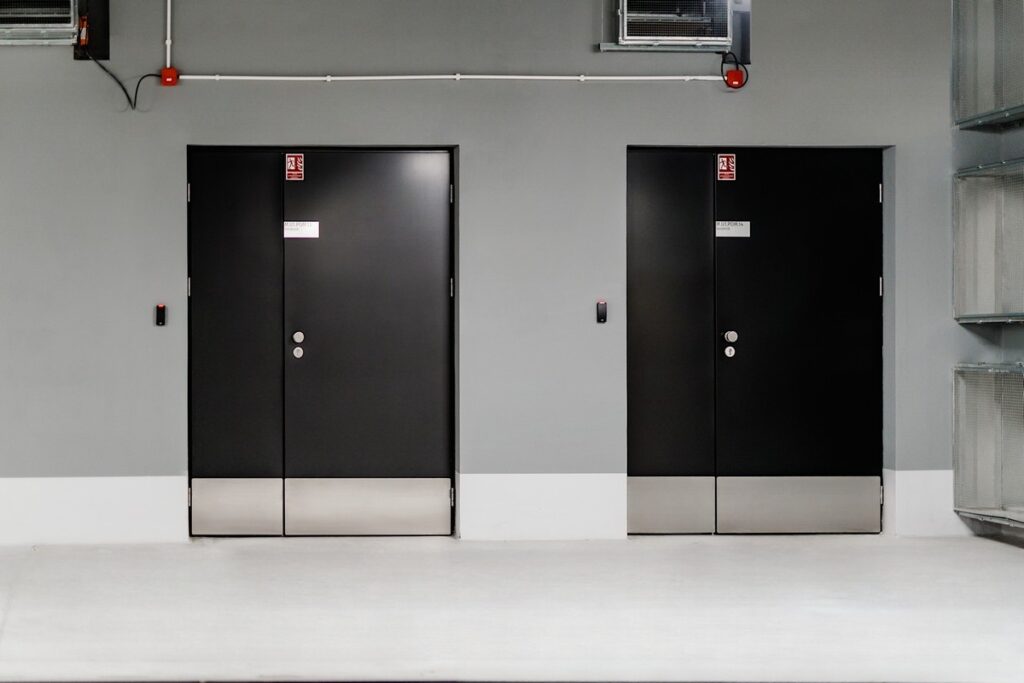
A steel fire door in a corridor and a steel fire door in an external wall can look almost identical. What separates them is not appearance but the set of performance requirements each has to meet, and the certification route that proves it. Specifying an internal-certified doorset into an external position is one of the more consequential mistakes on a project, because the certification simply does not cover the application.
What makes a door ‘external’?
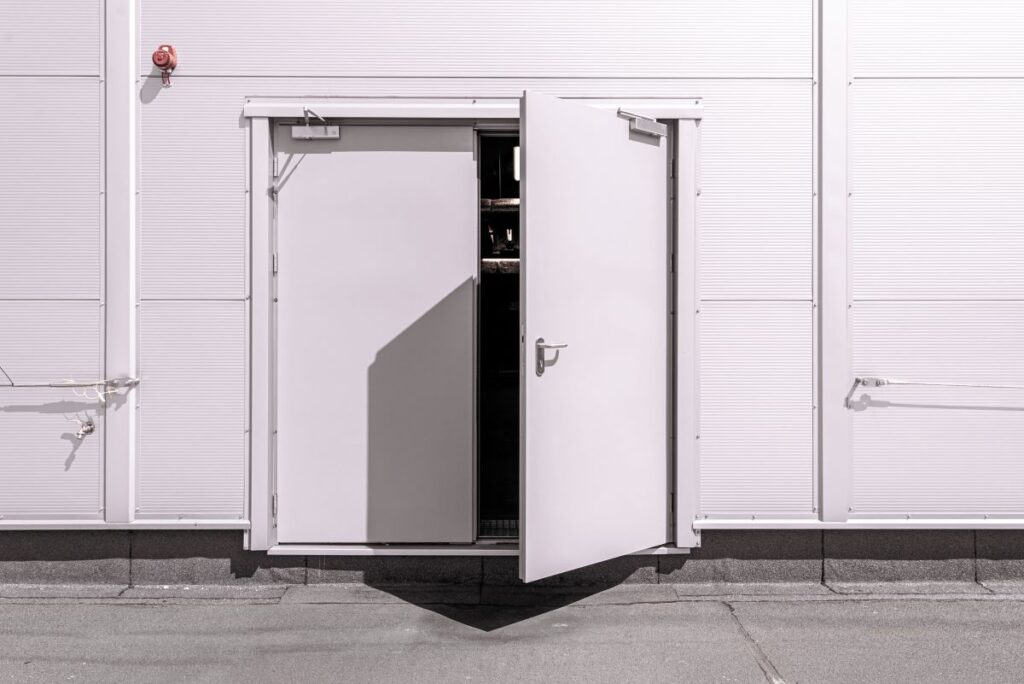
A door is external if it separates the interior of a building from the outside environment — an entrance door, a plant-room door in an external wall, a service door onto a yard. The defining factor is exposure to weather, not whether the door happens to be fire-rated. Once a door faces the elements, it inherits a set of performance demands an internal door never has to meet.
Different standards, different certification routes
Internal fire doorsets are CE marked under the harmonised standard EN 16034, using EN 1634-1 fire test evidence and EN 13501-2 classification. That route certifies fire and smoke performance. External fire doorsets carry the same fire requirements but are additionally assessed for weather performance, which brings a second harmonised standard and a broader set of tested characteristics into play.
This is why the two cannot be treated as interchangeable. The certification document for an internal doorset is silent on weathering; it makes no claim about water tightness or wind resistance because those were never in scope. DFM DS doorsets are CE marked for internal pedestrian fire-resisting applications under ETA-22/0324. For an external fire-rated position, the certification route differs — contact matthew.creely@dfm-doors.com to confirm the correct specification before it goes on a schedule.
An internal certification is silent on weathering — it makes no claim about water or wind, because those were never tested. That silence is why an internal door cannot simply be moved outside.
The performance an external door must add
Beyond fire and smoke, an external fire doorset typically has to demonstrate:
- Water tightness — resistance to driving rain penetrating the assembly.
- Wind load resistance — structural performance under positive and negative wind pressure.
- Air permeability — controlled leakage across the closed doorset.
- Thermal transmittance — a declared U-value, because the door is part of the building envelope and contributes to energy performance.
None of these applies to a purely internal door, which is why an external doorset is a more complex, more heavily tested product rather than an internal door fitted in an outside wall.
Thermal performance and the external door
Because an external doorset forms part of the thermal envelope, its U-value can matter to the building’s energy calculations. Worth noting a specification constraint here: a single leaf cannot always combine every performance attribute at once. A leaf configured for a high security rating and a fire rating, for example, will not simultaneously carry a declared thermal U-value — the requirements pull against one another in a single assembly. Where thermal, security and fire are all in play, the specification has to prioritise, and that is a conversation worth having before the schedule is fixed.
Getting the internal/external decision right
The practical rule is simple: identify whether each opening is internal or external before you select a product, and never assume a fire-rated door is valid in both positions. Confirm the certification route matches the application, check the Declaration of Performance actually covers the characteristics the opening demands, and where a door sits in an external wall, treat weather and thermal performance as requirements in their own right — not optional extras.
Frequently Asked Questions
Can an internal steel fire door be used in an external opening?
Not automatically. Internal fire doorsets are certified for fire and smoke performance only. An external opening also demands water tightness, wind resistance, air permeability and usually a declared U-value, which an internal certification does not cover. The correct route for an external fire-rated door differs — confirm the specification before use.
What is the difference between internal and external fire door certification?
Internal fire doorsets are CE marked under EN 16034 for fire and smoke performance. External fire doorsets must additionally meet weather-related performance under a separate harmonised standard. The DFM DS range is CE marked for internal applications under ETA-22/0324; external applications follow a different route.
What extra performance does an external fire door need?
Beyond fire and smoke, an external fire door typically has to demonstrate water tightness, wind load resistance, air permeability and thermal transmittance (a declared U-value), because it forms part of the building envelope and is exposed to weather.
Does an external fire door need a U-value?
Usually, yes. Because an external doorset is part of the thermal envelope, its U-value can feed the building’s energy performance calculations. Note that a single leaf cannot always combine a high security rating, a fire rating and a declared U-value at once — the specification may need to prioritise.
How do I know if a door counts as external?
A door is external if it separates the building interior from the outside environment and is exposed to weather — for example an entrance door or a plant-room door in an external wall. Exposure to the elements, not the fire rating, is what makes a door external for certification purposes.