
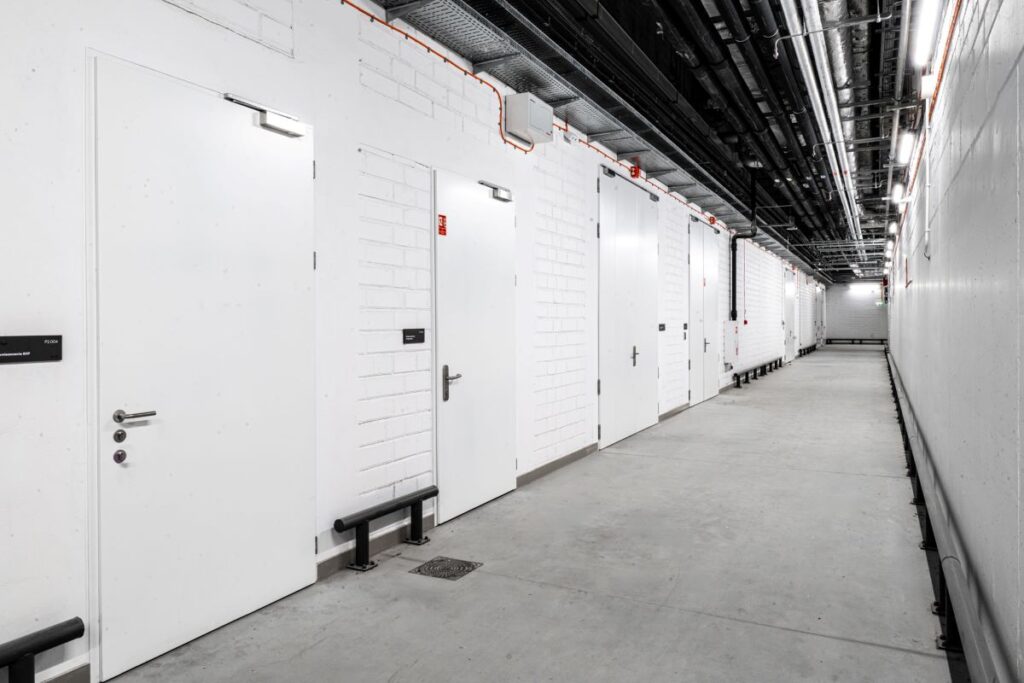

Data centres present a fire-door challenge most standard guidance does not directly address: high-value, high-density assets, continuous thermal load, large plant and equipment openings, and a fire strategy that frequently calls for the highest classifications available. Specifying to the generic commercial baseline is rarely enough.
For data centre applications, fire doors should be specified to the highest classification the fire strategy requires — typically EI₂ 120 for critical compartmentation. Insulation (the I in EI₂) matters under continuous thermal load, personnel access points use EI₂-classified steel doorsets, and large equipment openings are served by sliding fire gates rather than hinged leaves.
The combination of factors in a data centre pushes a fire-door specification beyond what general commercial guidance covers. Asset value is high, downtime is expensive, thermal loads are continuous, and the building contains openings far larger than a standard doorway. Each of these shapes the specification, and the right answer is usually the top of the classification range, not the middle.
Why EI₂ matters in a data centre environment
Data centres operate under continuous thermal load — server halls run hot by design, and in a fire event the air temperature rises quickly from an already-elevated baseline. An E-only fire door resists flame and hot gas but makes no promise about heat transfer through the assembly. In an environment where sensitive equipment sits on the other side of the compartment line, radiated heat through an E-only door can do damage long before flame would.
EI₂ means the door limits temperature rise on the unexposed face for the classified duration. EI₂ 120 — the highest duration in the DS range — gives two hours of both integrity and insulation. For critical compartmentation protecting server halls, UPS rooms or data suites, that insulation performance is the point, not an optional upgrade. Specifying E alone in this setting is a false economy.
In a server hall the asset you are protecting sits right on the compartment line. Radiated heat through an E-only door can destroy it long before flame arrives — which is why insulation, the I in EI₂, is the specification that matters here.
Standard personnel access — the DFM DS range
For personnel access points — server room entry, maintenance access, corridor compartmentation — the DFM DS range covers the requirement in steel, classified EI₂ from 30 to 120 minutes. EI₂ 120 is held as a standard catalogue item (DS 120-1S and DS 120-2S), not a bespoke build, so the highest classification carries no lead-time premium. Smoke control is available to Sa4 / S200 across DS 30, 60 and 120 where the strategy requires it.
| Opening type | Recommended specification |
|---|---|
| Critical compartmentation (server/UPS/data suite) | EI₂ 120 steel doorset, smoke control where required |
| Personnel access / corridor | DFM DS range, EI₂ to the strategy (30–120) |
| Large equipment / plant openings | Sliding fire gate (DFM SG), EI₂ to the strategy |
Large openings — sliding fire gates
Data centres contain openings a hinged doorset cannot practically serve: equipment delivery routes, plant access, large compartment boundaries. For these, a sliding fire gate is the appropriate solution. The DFM SG sliding fire gate range addresses large-span openings with fire classification maintained across the gate assembly, suitable for industrial and data centre compartmentation where a standard leaf would be too small or impractical to operate.
Where a large opening falls on a fire compartment line, it still has to meet the compartment’s fire requirement — the size of the opening does not relax the classification. Specifying a sliding fire gate to the same EI₂ performance as the surrounding construction keeps the compartment line continuous across openings a hinged door could never cover.
Bringing the specification together
A coherent data centre fire-door specification does three things: it sets the classification from the fire strategy and defaults to insulation performance (EI₂) given the thermal environment; it uses the DFM DS range for personnel access at the required duration; and it serves large openings with sliding fire gates at matching classification. Behind all of it sits the same evidence trail — EN 13501-2 classification, CE marking under ETA-22/0324, and the Declaration of Performance — that any Gateway submission will expect.
Specifying fire doors for a data centre project and want the classifications, personnel access and large-opening solutions set out correctly? Download the DFM Doors UK Technical Specification Guide, or contact Matthew Creely directly at matthew.creely@dfm-doors.com.
Frequently Asked Questions
What fire classification should data centre fire doors be?
Specify to the highest classification the fire strategy requires — typically EI₂ 120 for critical compartmentation protecting server halls, UPS rooms or data suites. Because data centres run under continuous thermal load, insulation performance (the I in EI₂) is important, not just integrity.
Why is EI₂ preferred over E for data centres?
An E-only door resists flame and hot gas but does not limit heat transfer through the assembly. In a data centre, sensitive equipment often sits right on the compartment line, where radiated heat through an E-only door can cause damage before flame would. EI₂ limits temperature rise on the unexposed face for the classified duration.
What doors are used for large equipment openings in data centres?
Large plant and equipment openings are served by sliding fire gates rather than hinged leaves. The DFM SG sliding fire gate range covers large-span openings while maintaining fire classification, suitable for data centre and industrial compartmentation where a standard door leaf would be impractical.
Is EI₂ 120 a special-order product?
No. In the DFM DS range, EI₂ 120 is held as a standard catalogue item (DS 120-1S and DS 120-2S), not a bespoke build, so the highest fire duration carries no lead-time premium. Smoke control to Sa4 / S200 is available across DS 30, 60 and 120 where required.
What evidence supports data centre fire door specifications?
The same evidence trail as any DFM DS specification: EN 13501-2 classification from EN 1634-1 test evidence, CE marking under ETA-22/0324 (OiB Vienna, Notified Body 1322), and a Declaration of Performance carrying the classification — the documentation a Gateway submission will expect.