
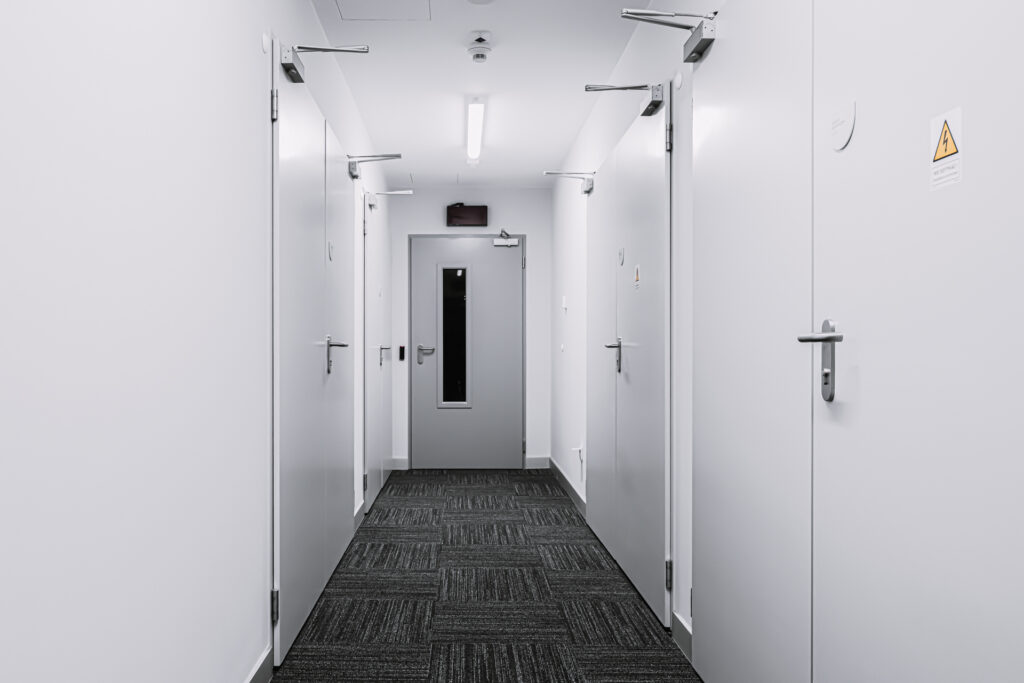
The CE mark points to a Declaration of Performance under EN 16034 — the mark is the signpost, the Declaration is the evidence.
CE marking on a steel fire door is not a tick-box. It is the legal mechanism by which a manufacturer declares what their product does — and the evidence chain behind that declaration is exactly what specifiers and duty-holders need to be able to interrogate.
Yes — fire-resisting steel doorsets placed on the market in Great Britain are CE marked, achieved through the harmonised standard EN 16034 with classification under EN 13501-2 based on EN 1634-1 fire test evidence. Every CE-marked doorset must be accompanied by a Declaration of Performance. The mark itself is only a pointer; the Declaration is the document that carries the proof.
The question in the title is asked more often than it should be, and usually because the CE mark is misunderstood as a stamp of general quality. It is not. It is a specific, standards-based declaration about fire performance, and understanding what it does and does not cover is the difference between accepting a door on sound evidence and accepting it on appearance.
What CE marking actually covers
When a steel fire door carries a CE mark, the manufacturer has assessed the product against the relevant harmonised standard and issued a Declaration of Performance stating the classification achieved. For a fire doorset that means several things are true at once:
- The fire resistance class — for example EI₂ 60 — has been determined from EN 1634-1 test evidence.
- The classification is expressed in EN 13501-2 terms, the common European language for fire performance.
- A notified body has been involved at the level of assessment the standard requires.
- A Declaration of Performance has been issued and is available on request.
What CE marking does not do is guarantee a door is right for a specific opening. The mark confirms the product was assessed and classified; it is still on the specifier to confirm that the classification and configuration match what the fire strategy calls for.
The CE mark confirms a door was assessed and classified. It does not confirm the door is right for your opening — that is still the specifier’s judgement.
Internal and external applications are different routes
Not every fire-rated steel door reaches its CE mark by the same route, and the internal-versus-external distinction is the one that catches people out. DFM DS doorsets are CE marked for internal pedestrian fire-resisting applications under ETA-22/0324, issued by OiB Vienna (Notified Body 1322). External fire-rated door applications involve additional performance requirements — weathering, water tightness, wind resistance, thermal transmittance — assessed under a different harmonised standard. Before specifying a DFM DS doorset in an external position, contact matthew.creely@dfm-doors.com to confirm the correct route.
How to verify CE marking
The mark on the door label or product documentation should be traceable to a Declaration of Performance. That Declaration references the harmonised standard (EN 16034), the classification (EN 13501-2), and the assessment body. For DFM DS doorsets it references ETA-22/0324 and the six independent test institutes whose evidence underpins it. If you can follow that trail from mark to Declaration to ETA to test evidence, the marking is sound. If the trail breaks at any point, it is not.
| Document | What it tells you |
|---|---|
| CE mark | The product has been assessed and a Declaration of Performance has been issued |
| Declaration of Performance | Classification achieved, harmonised standard referenced, notified body identified |
| ETA-22/0324 | Configuration tested, field of application, correct annex per installation type |
| Classification report | The independent test evidence behind the classification |
What changes at 2029
On 2 September 2029, BS 476-22 is withdrawn as a route to CE marking. This matters for manufacturers whose fire classification rests solely on BS 476 test evidence — they will need to retest to EN 1634-1 to keep placing product on the market. It does not affect doors already in service, and it does not make E-rated doors non-compliant. It is a change to the evidence route, not to the products themselves.
For a manufacturer already classified under EN 13501-2 on EN 1634-1 evidence, no transition is required. DFM DS doorsets fall into that category: they are EN-classified today, so a specification that references DFM DS with the correct EN classification carries through 2029 without further action. That is the practical value of specifying on EN evidence now rather than waiting.
Frequently Asked Questions
Fire-resisting steel doorsets placed on the market in Great Britain are CE marked under the harmonised standard EN 16034. The mark must be accompanied by a Declaration of Performance stating the EN 13501-2 classification achieved from EN 1634-1 test evidence.
Is the CE mark alone enough to prove a fire door’s performance?
No. The mark is a pointer to the Declaration of Performance, which is the document that actually states what was tested and to what classification. Always verify the Declaration, not just the presence of the mark.
What is the difference between CE marking for internal and external fire doors?
Internal fire doorsets are CE marked under EN 16034 for fire performance. External fire doorsets must additionally meet weathering, water tightness, wind resistance and thermal requirements under a separate harmonised standard, so the certification route differs. DFM DS is CE marked for internal applications under ETA-22/0324.
Does the 2029 BS 476 withdrawal remove CE marking from fire doors?
No. It withdraws BS 476-22 as an accepted route to CE marking. Manufacturers relying solely on BS 476 evidence must retest to EN 1634-1. Doors already installed remain valid, and EN-classified products like DFM DS need no transition.
How do I check a steel fire door’s CE marking is genuine?
Trace the mark to its Declaration of Performance, confirm the Declaration cites EN 16034 and the correct EN 13501-2 classification, and check the referenced ETA (ETA-22/0324 for DFM DS) covers the configuration installed. A complete trail from mark to test evidence is what validates the marking.
- Fire Door Performance Ratings Explained
 Integrity, insulation, smoke, acoustic, thermal, security — a steel fire door carries several performance ratings at once. What each one measures and how to read them together.
 - External vs Internal Steel Fire Doors: What’s the Difference?
 Internal and external fire doors look similar but are certified as separate products, against different standards and performance demands.