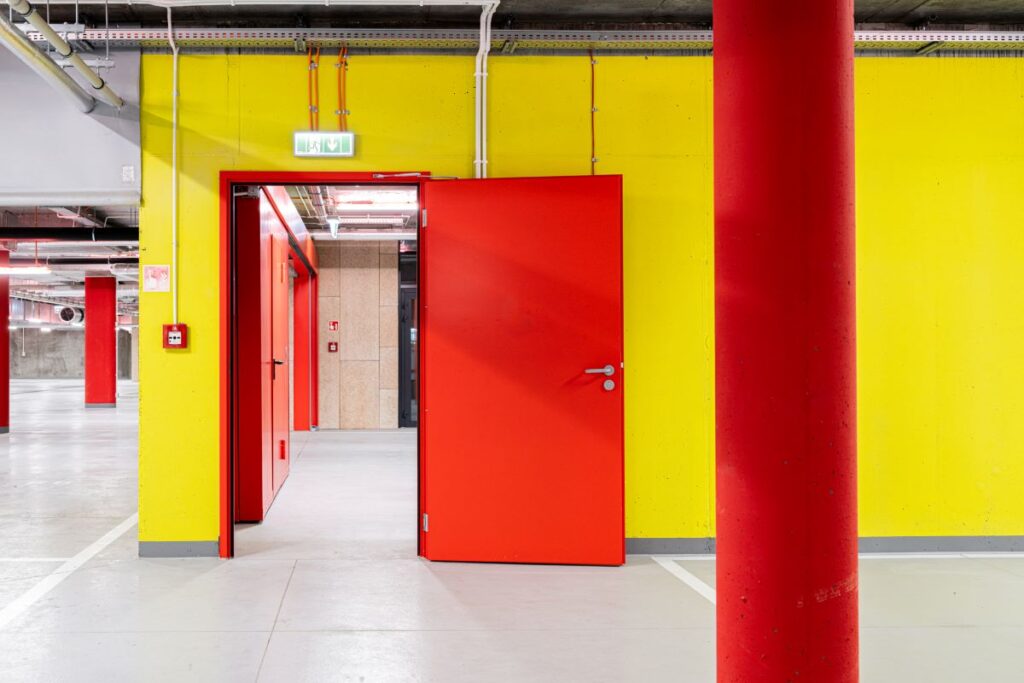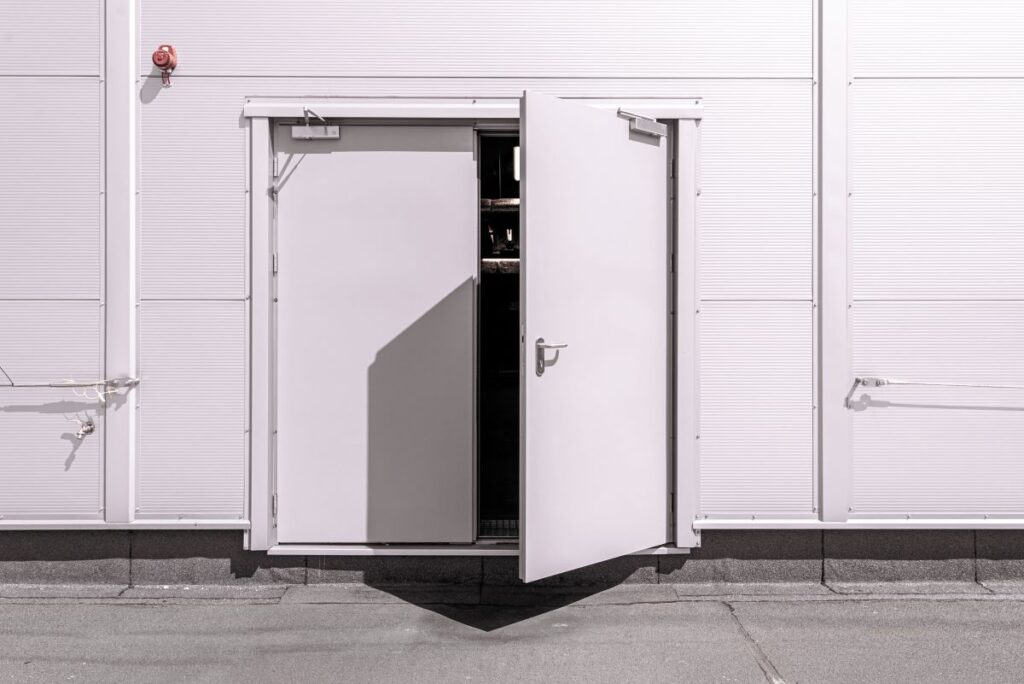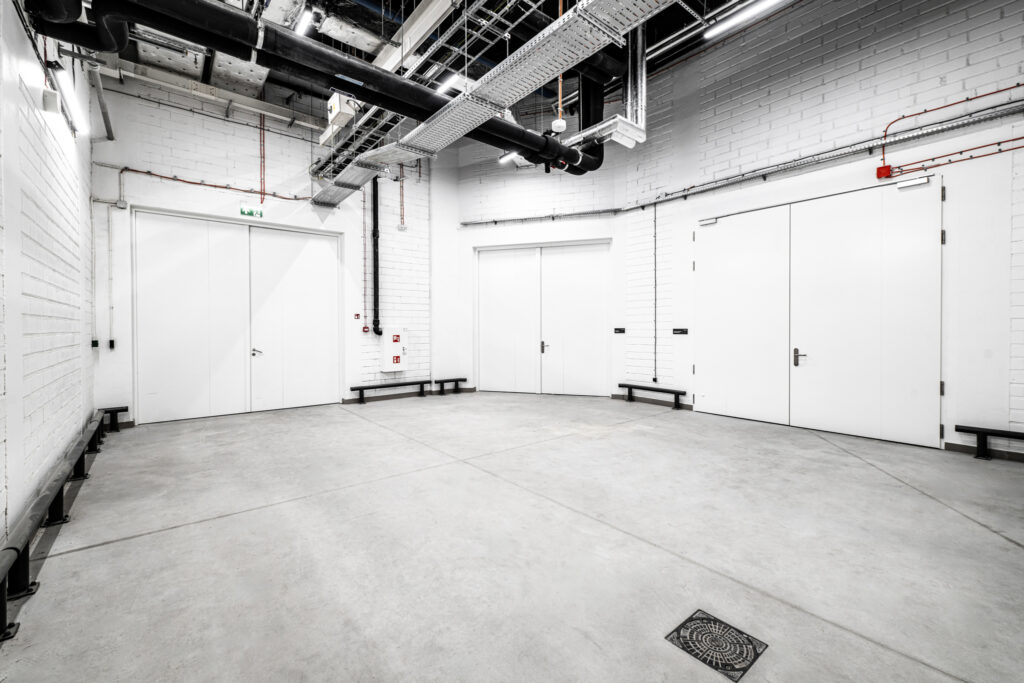
A steel fire doorset with its documentation pack — the Declaration of Performance, ETA reference and installation record are what prove compliance, not the door’s appearance.
A fire door that looks right is not the same as a fire door that is right. On a Building Safety Act project, the difference is documentation — and documentation is the first thing an inspector challenges and the thing most likely to fail.
A compliant steel fire door carries a valid EN 13501-2 classification, is CE marked under EN 16034 with a Declaration of Performance, and is installed strictly in line with the relevant European Technical Assessment. Classification, certification and installation must all describe the same doorset — leaf, frame, hardware and glazing. If any one of the four cannot be evidenced, the door is not compliant.
Compliance is not a quality you can see. A well-made steel doorset and a non-compliant one can look identical hanging in an opening. What separates them is a chain of evidence: a classification that states what the door was tested to do, a certification route that makes that claim legally, and an installation that matches the configuration the classification was awarded to. This guide walks each link in that chain, in the order a specifier, contractor or building manager should check them.
What fire classification does a steel fire door need?
The classification must be expressed in EN 13501-2 terms — a letter sequence followed by a time in minutes. EI₂ 60 means the doorset was independently verified to resist both fire integrity (E) and thermal insulation (I) for 60 minutes. That verification comes from an EN 1634-1 fire test, a different and more specific method than the BS 476-22 test that underpins legacy FD ratings.
A door schedule entry that states only FD60 is incomplete. FD60 references a BS 476 result; it does not tell you whether the door limits heat transfer on the unexposed face, which is what the insulation classification captures. The EN classification — EI₂ 60, or whatever the fire strategy calls for — must be stated, and the manufacturer must be able to supply a Declaration of Performance that carries it. If they cannot, the door does not meet current specification standards.
Classification, certification and installation must all describe the same doorset. If any one of the four elements cannot be evidenced, the door is not compliant.
How do you check CE marking on a steel fire door?
CE marking on a fire doorset means the manufacturer has issued a Declaration of Performance against a harmonised standard. For steel fire doors that standard is EN 16034, used with EN 1634-1 test evidence and EN 13501-2 classification. The mark on its own evidences nothing — it is a pointer to the Declaration of Performance behind it, and that document is what you actually verify.
Three things to confirm at delivery and at practical completion:
- The mark is present on the doorset label or the accompanying documentation.
- A Declaration of Performance is available and cites EN 16034 as the harmonised standard.
- The classification on that Declaration matches the classification written into the door schedule.
If the Declaration cannot be produced, or if its classification differs from what was specified, the door is not CE marked for the application as installed — regardless of what the label shows.
What is a Declaration of Performance, and what must it state?
The Declaration of Performance is the legal document that substantiates the CE mark. It is not a brochure or a data sheet. It must state the product name and description, the harmonised standard it is assessed against (EN 16034), the EN 13501-2 classification or classifications achieved, the notified body that carried out the assessment, and the manufacturer’s name and registered address.
A steel fire door without a retrievable Declaration of Performance should not be specified or accepted on site. It is the first document a Gateway inspector, a building control officer or a fire engineer will ask to see. For DFM DS doorsets, every Declaration references ETA-22/0324, issued by OiB Vienna (Notified Body 1322). The classification evidence behind it was generated at six independent European test institutes: ITB, Efectis France, Efectis Netherlands, KIWA, OiB and RISE.
What is a European Technical Assessment (ETA)?
A European Technical Assessment is an assessment document — not a test report — issued by a Technical Assessment Body. It defines the product’s essential characteristics, the test evidence underpinning each, and, critically, the field of application: the range of sizes, frame types, hardware and configurations within which the classification remains valid.
This is where compliance is most often lost. A doorset installed outside its ETA configuration is not covered by that ETA, even if it carries the same CE mark and the same Declaration of Performance. A different frame type, an unlisted hardware item, or a perimeter gap filled with the wrong material can each take an installation outside its certified scope. DFM DS doorsets are covered by ETA-22/0324, revised in May 2024. The document runs to 276 pages and 25 installation annexes; the correct annex for each installation must be identified and followed.
Why the installation must match the ETA
Classification is only maintained when the doorset is installed exactly as the ETA specifies. Frame fixing, structural gap tolerances, perimeter fill material, hardware and any glazing must all match the tested and assessed assembly. A deviation that looks minor on site can invalidate the classification.
A specific guardrail worth writing into every DS 120 specification: the structural perimeter gap must be filled with cement mortar or lime-cement mortar only. Mineral wool is not approved for that application on DS 120, and using it takes the installation outside the ETA configuration. At practical completion, the installation record should confirm the annex followed, the gap-fill material used, and the hardware fitted — that record is part of the Gateway documentation package.
Frequently Asked Questions
It must carry a valid EN 13501-2 classification, be CE marked under EN 16034 with a Declaration of Performance, and be installed in line with the relevant ETA configuration. All three are required. A CE-marked door installed outside its ETA annex is not compliant, and a door with an ETA but no CE mark is not compliant.
Can a fire door be compliant without a Declaration of Performance?
No. The Declaration of Performance is the legal mechanism that substantiates the CE mark. Without it the mark cannot be verified. A manufacturer who cannot produce one on request has not completed the CE marking process correctly.
Is an FD60 fire door the same as an EI₂ 60 fire door?
Not necessarily. FD60 references a BS 476-22 test result; EI₂ 60 is an EN 13501-2 classification from an EN 1634-1 test. Both address 60-minute performance, but via different methods and measurement criteria. An FD60 door may carry only an integrity (E) classification in EN terms, or it may carry EI. Specify using the EN classification.
What happens if a fire door is installed outside its ETA configuration?
The classification is invalidated. The door may be physically installed, but its fire performance is no longer certified for that installation. Changing the frame type, using an unlisted hardware item, or using the wrong gap-fill material can all take an installation outside its ETA field of application.
Do internal steel fire doors need CE marking?
Yes — fire-resisting doorsets placed on the market in Great Britain are CE marked under the harmonised standard EN 16034. The DFM DS range is CE marked for internal pedestrian fire-resisting applications under ETA-22/0324. External fire-rated applications follow a different certification route.
How do I verify that a steel fire door has a valid ETA?
Request the Declaration of Performance; it will reference the ETA number. ETA-22/0324 is a public document available from OiB Vienna, and can be used to confirm the field of application for any DFM DS doorset. Cross-reference the ETA against the doorset actually installed to confirm the configuration is within scope.
Specifying a fire door schedule and want the classifications and evidence right first time? Contact Matthew Creely directly at matthew.creely@dfm-doors.com.